

The Case for Conducting Assessments Via Telehealth
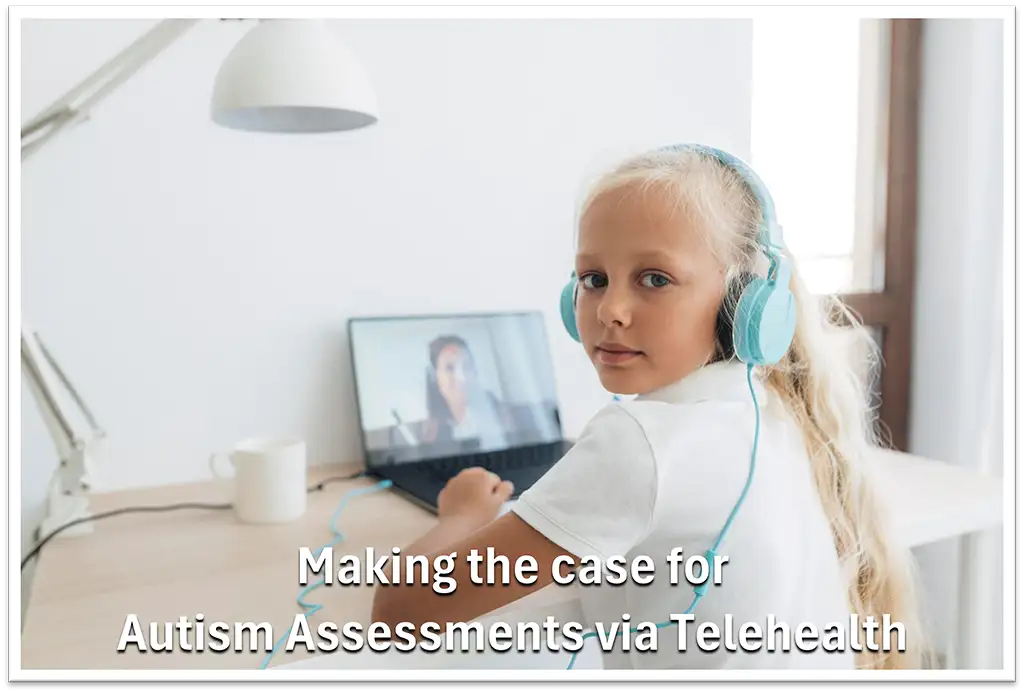
For decades, the standard path to an autism diagnosis meant long waitlists, unfamiliar medical offices, and stressful clinical environments. For many neurodivergent individuals and their families, the journey to answers was often as exhausting as it was necessary.
Beyond the Clinic Walls: The Case for Telehealth Autism Assessments
Fortunately, clinical practice has evolved. Telehealth Autism Assessments are now a widely accepted, highly accurate alternative to traditional in-person evaluations. Backed by rigorous studies, a landmark comprehensive meta-analysis published by Wang et al. demonstrated that remote evaluations show a high diagnostic accuracy, proving that clinicians do not need to be in the same physical room to understand an individual’s unique neurodevelopmental profile.
By shifting the evaluation from a rigid clinic to a virtual platform, remote assessments bridge critical healthcare gaps while prioritizing patient comfort.
The Advantages of an Assessment Via Telehealth
- Natural Environment: Clinicians observe true-to-life behaviours in a comfortable, familiar home setting
- Reduced Sensory Overload: Eliminates bright clinic lights, new smells and stressful travel routines
- Accelerated Timelines: Drastically cuts down traditional in-person waitlists from months to weeks
- Geographic Freedom: Connects regional or remote families with specialized, expert diagnostic clinicians, regardless of their own location
- Transport Logistics: Less travelling means reduced time and cost for families

Understanding the Process: How Virtual Diagnosis Works
A virtual assessment is not a simplified shortcut; it follows the exact same diagnostic guidelines as a face-to-face appointment. Clinicians use robust, evidence-based frameworks to build a comprehensive clinical picture:
- In-Depth Clinical Interviews: Psychologists spend dedicated time with the individual, their caregivers or their teachers, mapping out developmental history, communication styles, and behavioural milestones.
- Direct Observation: Our clinicians can directly observe natural play, social cues, and communication habits over video, and oftentimes, this comes more naturally than it would in a clinic.
- Validated Diagnostic Questionnaires: We use standardised software, such as the Vineland 3, which is completed via secure digital portals, to measure adaptive functioning across communication, daily living skills and socialisation.
- Comprehensive Feedback Reports: The process concludes with a detailed, formal report that meets national standards, allowing families to access targeted support, school accommodations, or NDIS funding if applicable.
Striking the Right Balance: The Value of Masking Removal
One of the greatest clinical strengths of telehealth is seeing a reduction in “masking.” In an unfamiliar medical setting, many autistic children and adults instinctively mask their traits due to anxiety, trying to conform to the new environment.
At home, surrounding by their own comforts and routines, patients are much more likely to show their authentic selves. They can display their true sensory preferences, stimming behaviours or communication barriers, without the added pressure of a sterile clinic room. This gives evaluators a clearer, more accurate view of their daily functional needs.
When Is In-Person Still Needed?
While virtual assessments are highly effective for most, they are not a one-size-fits-all solution. If an individual has a highly complex co-occurring medical presentation, significant language barriers, or if the clinician encounters technology limitations that block subtle social cues, a hybrid or fully face-to-face approach may still be recommended. Ultimately, telehealth serves as a powerful, neuro-affirming tool that opens doors to understanding and validation far faster than standard waiting lists ever could.
Frequently Asked Questions
- Can a video call provide an accurate diagnosis?
Yes. Validated virtual observation tools allow specialists to evaluate social communication, play, and behavioural patterns with high precision. - Is a telehealth assessment legally recognized?
Yes. As long as the evaluating clinician uses standardized diagnostic criteria, the resulting report holds the same legal and funding weight as an in-person assessment. - What happens if my child refuses to sit in front of the camera?
Clinicians do not expect perfection. They often instruct parents to set up the camera to capture natural play while the child moves freely around the room. - How do you handle technical issues like a dropped internet connection?
Providers anticipate glitches. They usually have a backup plan, such as switching to a phone call or scheduling a brief follow-up session to complete the assessment. - Can adults be assessed for autism via telehealth?
Absolutely. Virtual assessments are highly effective for adults, as the process relies heavily on clinical interviews, developmental history, and self-reported questionnaires.
If you’d like to find out more about One Central Health, contact us today via our enquiry form or by calling (08) 9344 1318.
ALL Images Courtesy of FREEP!K/Magnific